


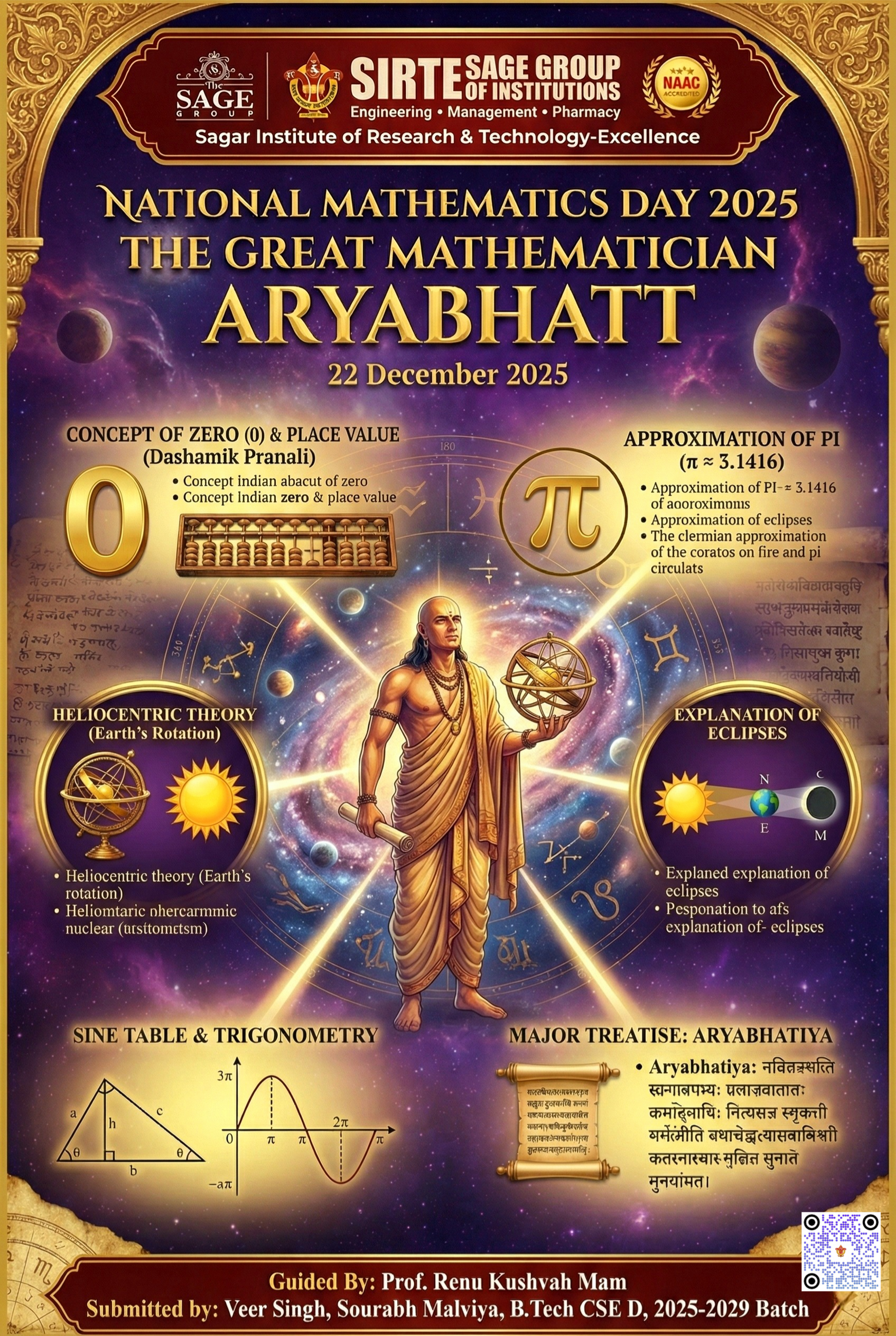

Aryabhatta (476–550 CE) stands as the colossal figure of the classical age of Indian mathematics and astronomy. Born in Kusumapura, his work represents the zenith of scientific inquiry in ancient India.
At the remarkably young age of 23, he authored the Aryabhatiya. This defining treatise laid the groundwork for future developments in trigonometry, algebra, and arithmetic, influencing scholars across the globe for centuries.
Aryabhatta's brilliance lay in explicitly utilizing the concept of zero as a placeholder. He referred to it using words like 'kha' (space) or 'purna' (full). This innovation, the decimal place-value system (Dashamik Pranali), transformed mathematics into an efficient system where a digit's position determines its value.
In the Aryabhatiya, he provided a stunningly accurate value for Pi. He stated: "Add four to 100, multiply by eight, and then add 62,000. By this rule the circumference of a circle with a diameter of 20,000 can be approached."
Crucially, he used the term "asanna" (approximate), indicating an understanding that Pi is an irrational number.
In a bold departure from prevailing models, Aryabhatta correctly propounded that the Earth rotates on its own axis daily. He elegantly explained that the apparent westward movement of stars is a relative motion caused by the Earth spinning eastward, using the analogy of a person in a moving boat feeling stationary objects on the bank are moving.
Aryabhatta is considered a father of trigonometry. He introduced functions based on half-chords of a circle, defining terms like jya (sine), kojya (cosine), and utkrama-jya (versine). He generated sine tables essential for astronomy. The word 'sine' itself evolved from his term 'jya'.
Drag the slider to align the Moon between Sun and Earth to create a Solar Eclipse!
Enter a modern year to find its equivalent in the ancient Kali Yuga epoch (started 3102 BCE).
Enter a large number to see it built exponentially with ancient Sanskrit terms!
Visualize Aryabhatta's theory of a spinning Earth versus a stationary sky.
Aryabhatta calculated the Earth's orbit duration incredibly accurately. Which of these ancient coded values represents his calculation of approx. 365.258 days?
Aryabhatta mapped the skies. Click on the canvas to connect stars and reveal a cosmic pattern!